Here’s To A Better And Job Scam-Free 2025
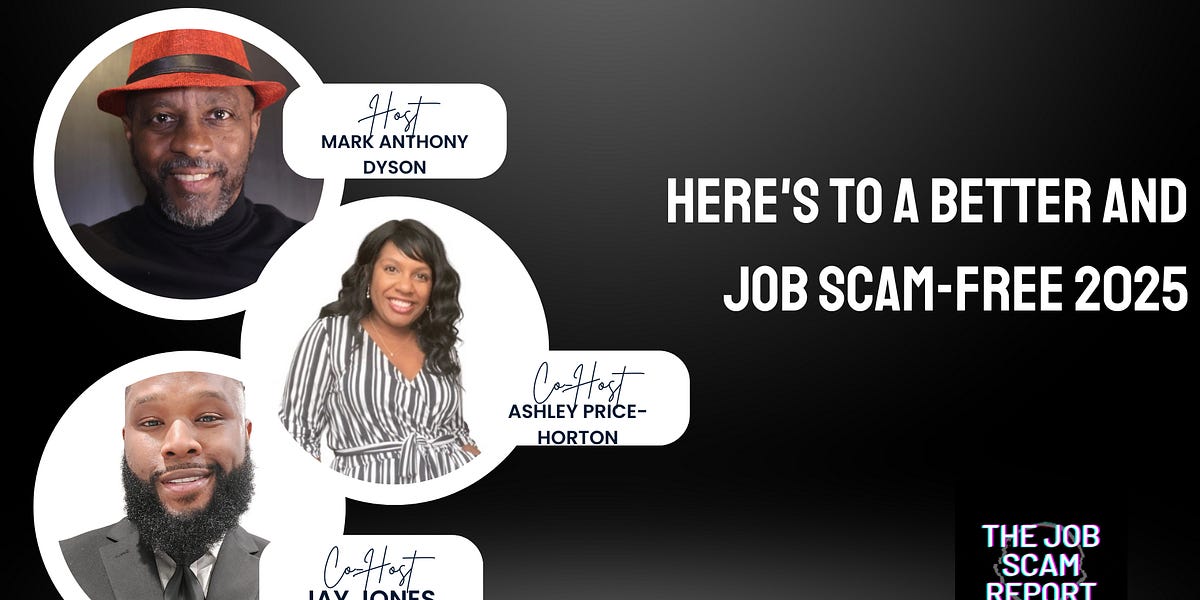

In this week’s episode of “The Job Scam Report” podcast, Jay Jones and I deeply differentiate fake jobs from ghost jobs. Both are distracting to job seekers, yet one is a direct threat to their personal information. In either scenario, giving information away does not benefit them, which is counterproductive.
We dearly missed our other co-host, Ashley Price-Horton, whose valuable recruiter experience and insight inject a deeper understanding of the hiring process.
– Job scams: Fake jobs and ghost jobs
– Job search, LinkedIn’s role
– Educating on job scams
– Ahead of news in job scams
– LinkedIn profiles as real-time news sources
– Job scams are increasingly vital to understand
– Encouragement for audience participation
– Platform for questions and comments
Fake Jobs
– Created by fake companies
– Aim: capture personal information, financial schemes
– Techniques: Long-winded job descriptions, fake ATS compatibility
– Posted by legitimate companies without hiring intent
– Collect personal information, test job market
– Often reposted without filling
– Derived from non-existent companies
– Immediate recruiter contact
– Financial deceit involved
– Real companies, no hiring intent
– Data collection
– Build candidate pipeline
– Use of real identities by scammers
– Scamming job seekers with stolen identities
– Companies sometimes spoofed
– Verify company and job authenticity
– Contact the company directly or look for a genuine recruiter
– Use Google search with job descriptions
– Be wary of no company website, recruiter activity
– Engage companies directly
– Use resources like LinkedIn carefully
– Watch for recruiter and company activity
– Use reverse image search to verify profile pictures
– Use of AI in job applications
– Scammers using AI to generate large-scale scams
– Understanding ATS (Applicant Tracking Systems)
– Apply diligence in job applications
– Be aware of communications from recruiters or companies
– Understand scoring within ATS
– Use the “Open to Work” banner cautiously
– Fake jobs on LinkedIn
– The legitimacy of job postings
– Keep communication open with potential employers
– Understand the job market and company strategies
– Potential discussions with cybersecurity professionals
– Substack private sessions for paid members
– The importance of industry networks and organizations
– Strategies beyond cold applications
– Watch for telltale signs of job scams
I wanted to point out other meaningful job search resources to help you get traction with your job search. All of these resources offer expert advice and practical actions to take to get results. Only the last newsletter mentioned is NOT a Substack newsletter:
Alison Doyle and Jen Luckwaldt, the authors of this Substack, have penned several thousand articles on job search and careers. I believe we both began on Substack around the same time. They also highlight job scams, particularly in their piece about the “Open To Work” badge.
Nick Kossavan is a columnist and an experienced Call Center Manager who has written thousands of articles on job search and careers. One of his latest articles on Substack, 2025 Job Market: What’s Not Changing, is a straightforward treatise in which he points out that the value of numbers on your resume is essential for hiring managers to consider.
Hannah Morgan’s popular newsletter, Career Essentials (formerly Sunday Summary), is a potpourri of career advice, a practical roadmap to success. Her non-fluff action items are broken down into easy-to-follow small bits of guidance. In addition, she shares some of the best career reads, podcasts, and videos on the Internet. Her site, CareerSherpa, is one of the industry’s longest and most popular blogs.
Sarah Johnston’s newsletter focuses on the needs of executives and is filled with C-level job search strategies. While you can get a version of her newsletter on LinkedIn, receiving it in your email box is valuable. I enjoy the interviews with experts who shed real-world insights. I especially find the occasional expert interviews and the branding insights she provides. Her latest newsletter from a couple of weeks ago is a great example.
link