A framework for the facilitation of accelerated leadership and management capability development in the workplace

The framework integrates relevant theories and concepts from a variety of adult learning theories most relevant to workplace learning contexts and to leader development in particular. We draw on adult learning theorists (many are seminal authors), and their associated works, in Fig. 1 below. The following discussion and review details these theoretical underpinnings which have informed the development of the leadership and management learning framework and its key elements.
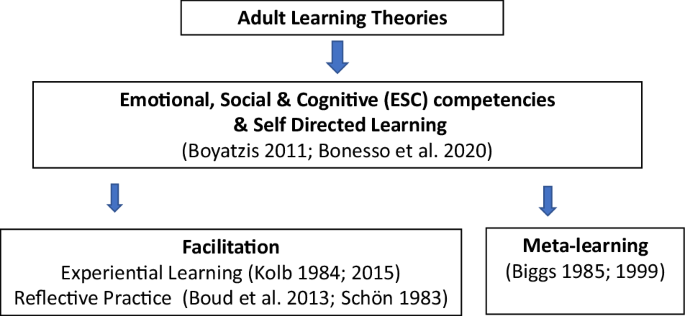
This figure describes the high-level adult learning theories that inform the framework.
Development of leadership and management competencies
The framework provides guidelines for the design of facilitated learning interventions to accelerate leadership and management capability development. The outcomes from such program interventions are ultimately measured by the individual participant’s leadership and management performance in the workplace. Optimal performance in a work role occurs when ‘the person’s capability or talent is consistent with the needs of the job demands and the organizational environment’ (Boyatzis 2011, p. 92). Boyatzis (2011) contends the intentional development of leadership and management capability necessitates a focus on the development of three clusters of leadership and management competencies: Emotional Intelligence, Social Intelligence and Cognitive (ESC) competencies.
Several recent studies have underscored the positive influence of ESC competencies on leadership and management performance. Edelman and van Knippenberg (2018) provide evidence that leaders with elevated levels of Emotional Intelligence (EI) are better able to respond to the emotional needs of their staff, a critical enabler of leadership effectiveness. Rosete and Ciarrochi (2005) studied Australian public service leaders and found that higher levels of EI correlated with higher leadership effectiveness. Research undertaken by Boyatzis et al. (2023) assessed the behavioral emotional and social intelligence competencies of coaches over a 2-year period and found the most effective coaches utilized the following competences: achievement orientated; adaptability, emotional self-control, empathy, organizational assessment, and influence.
These ESC competencies are not only predictive of performance, they can also be developed through formal learning and development programs. Bonesso et al. (2020) report on the outcomes of a systematic review of multiple academic studies that have demonstrated that leadership and management competencies, and specifically the ESC competencies, can be developed through a range of different learning interventions and techniques including experiential approaches, reflective practice, role plays, coaching, and simulation.
Notwithstanding this demonstrated capacity to develop ESC competencies that underpin effective leadership and management performance, much of the academic leadership and management development literature is critical of competency approaches. For example, in a review of twenty-nine competency frameworks internationally, and an analysis of reflective participant reports, Bolden and Gosling (2006) concluded the competency approach is overly reductionist and fails to encapsulate the complexity of leadership roles and performance. Such criticisms may apply fairly to some competency-based approaches to leadership and management development, but they do not apply to all. Much of the competency-based literature does not contend that possession of leadership and management competencies means that a person will be an effective manager or leader (Bonesso et al. 2020; Boyatzis 2011). Similarly, the literature does not support the view that effective managers have the same skillset executed the same way – rather, the evidence suggests that capable leaders and managers possess a range of competencies such as the ESC competencies discussed above, and further that these can be developed (Boyatzis 2011).
Competencies and competency standards provide a language to discuss leadership and management performance. They are not the performance, nor are they the knowledge, skills, behaviors, or attitudes that underpin the performance. Rather, we contend that competency is the demonstrated ability (measurability) to perform a function reliably to a defined standard. Competency standards provide the language to describe the required performance. Thus, there is no one ‘correct’ or definitive competency framework, as suggested by Bolden and Gosling (2006), any more than there is one ‘correct’ description of an artistic work. There are, however, generally-accepted, and useful frameworks, such as the ESC competencies, which provide a language to describe competent performance.
The framework is most relevant to situations where an organization wants to develop the capability of the group of individuals. For example, the organization might want to implement new agile project management practices. To do so it requires managers to lead the organizational change and to facilitate the development of agile work practices in the organization. Such a capability requires several core competencies for managers including mastery of the agile process itself, change management, leading and facilitating agile project groups, and coaching for performance. Such a program of development might be undertaken over a period of time such as 6 to 12 months. Facilitating the design, development, and implementation of such a program is a critical role of the facilitator and central to the leadership and management learning framework.
Facilitation
The second key element of the frameworkis facilitation which Burrows (1997) describes as a partnership between the learner and the facilitator. There is a close connection between the partners in learning that involves the practice of critical reflection (Raelin 2006). In this learning partnership the facilitator often takes a leading role, however, there is a shared responsibility through the respectful negotiation of learning goals and strategies. An essential role of the facilitator is to guide the learner through critical reflection by questioning, probing, and challenging assumptions (Burrows 1997). The facilitator is not a passive partner in the learning process. Facilitation is an intentional, dynamic concept with clearly defined goals and planned development interventions.
The intention of this framework is principally to guide the role of external facilitators engaged specifically to plan, design, develop, deliver, and evaluate a program or intervention to accelerate leadership and management capability learning. The facilitator might be a leader responsible for supporting (facilitating) leadership and management capability development of a group or individuals. Identifying, agreeing to, and achieving the learning goals is a shared responsibility of the learner, facilitator, and the organizational sponsor. The facilitator is an active partner in the learning process and may fulfill a number of different roles, depending on the context and needs, including, for example: guiding the learner through critical reflection by questioning, probing, and challenging assumptions (Burrows 1997); guiding group learning and interaction; explaining and communicating information, concepts and tools that can be used to develop leadership and management competence; and inspiring participants to want to learn and to feel confident in their own ability to do so.
The role of the skilled facilitator of leadership and management learning and capability development is to support an iterative, continuous learning process as described in Fig. 2. This continuous learning process reflects the learning phases of several self-development models including Nesbit’s SLDL framework (Nesbit 2012), Boyatzis’ model of self-directed learning (Boyatzis et al. 2002) and other models of self-managed learning (for example, Panadero et al. 2015). Unlike those models however, the framework adds the role of the facilitator, shown in the outer circle of the diagram (see Fig. 2), to support all phases of the learning process from needs assessment through planning, learning, applying, and evaluating.
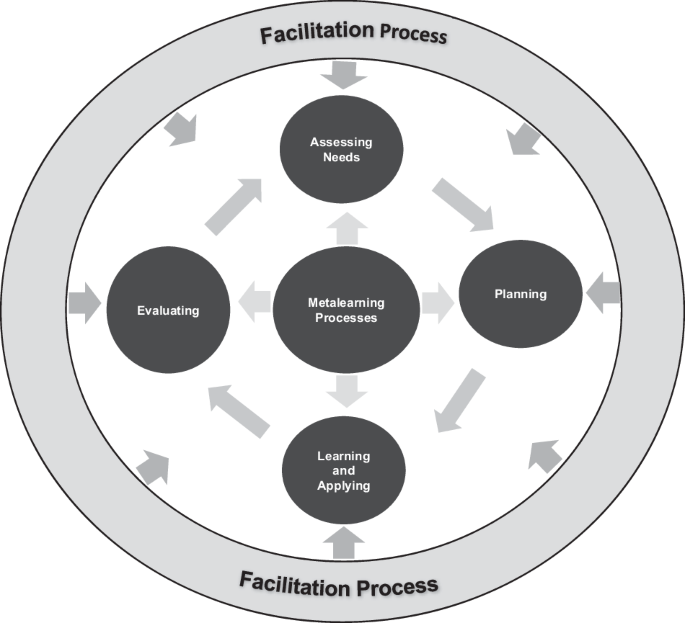
This figure describes the role of the skilled facilitator of LEADERSHIP AND MANAGEMENT learning and capability development to support iterative, continuous learning and mastering competency.
Facilitated continuous learning process
This facilitated continuous learning process is a general learning process applicable to learning and mastering competency. This focus on competency development distinguishes it from the seminal work of Kolb and the learning cycle which involves four phases or stages of learning focused on the creation of knowledge through the transformation of experience (Kolb 1984). Not all learning requires abstract conceptualization. For example, mastering a skill may require incremental practice to improve proficiency. This application coupled with feedback and reflection helps the individual to understand gaps in performance and to rectify these accordingly.
The continuous learning process starts with the learner, with the support of a facilitator, analyzing and understanding learning needs. For example, to learn how to effectively supervise staff, an important skill or competency would be the ability to provide coaching or timely and constructive feedback. To achieve competency the learner needs firstly to understand what skills or capabilities need to be developed. Next, together, the learner and facilitator plan how best to build upon the identified areas for development and agree on learning goals. Finally, the learner implements the plan (with the guidance of the facilitator), undertaking agreed learning strategies and applying and practicing the learning in context. So, to learn how to coach staff, the learner may undertake some structured learning that provides the learner with an understanding of the coaching process, then take on opportunities to practice their skills in a safe environment and receive feedback on their performance.
Finally, in the evaluation stage of the facilitated continuous learning process, the learner, with the facilitator, reflects upon their learnings and practice, seeking and receiving feedback on their performance to evaluate how the learner is progressing towards their learning goals to again determine their learning needs and repeat the entire process. Each of these phases in the facilitated continuous learning process necessitate external input from a skilled facilitator to provide guidance and direction as to the learning needs, provide advice about the progress the learner is making towards their goals, ensure access to learning resources, and provide feedback about performance.
Workplace learning processes and metalearning
The third defining feature of the framework is the workplace learning processes that enable leadership and management competency development, and specifically meta-learning processes. Concerned with the learner’s understanding of the phenomenon of learning itself, rather than the subject matter, meta-learning refers to the metacognitive process that connects the individual’s learning motives with strategies. It involves self-knowledge about how one learns, specifically an awareness of the learning strategies and behaviours applicable to a learning context (Boström and Lassen 2006; Jackson 2004).
We now provide definitions for these related concepts of metacognition, meta-learning, and meta-skills. John Flavell a developmental psychologist first coined the term metacognition in the 1970s and defines it as ‘one’s knowledge concerning one’s own cognitive processes and products or anything related to them’ (Flavell 1979, p. 232 in Mahdavi 2014, p530). In other words, metacognition refers to one’s awareness and understanding of their cognitive processes, sometimes referred to as thinking about thinking. It also involves monitoring, controlling, and regulating one’s own thinking. Secondly, meta-learning refers to the meta-cognitive processes specifically involved with the learner’s choice of learning processes or strategies (Biggs 1985). Put more specifically, meta-learning involves understanding one’s learning preferences, strengths, and weaknesses, and more highly developed meta-learning capability involves more sophisticated choice and application of learning strategies appropriate to the learning goals and context. Lastly, meta-skills, in a workplace context, are the higher order skills that facilitate effective learning in the workplace. Effective workplace learners need to be very open, able to seek feedback, and able to accept negative feedback and manage their emotional responses to it (Nesbit 2012; Spreitzer et al. 1997).
In a higher education learning context, to achieve a motive of mastering a topic, a learner might decide to use a strategy such as summarizing the main ideas of an article (Hogan et al. 2015; Huntley-Moore and O’Connor 2014). Such an approach is referred to as a deep approach to learning, whereas a surface approach involves the learner rote learning the content of the subject in order to reproduce it, such as for a test or exam, rather than to understand content (Biggs 1979; Marton and Säljö 1976; Stover and Seemiller 2017). Supporting the meta-learning helps learners to become more aware of their self-regulatory behaviours and to recognize the effectiveness of learning strategies they use, and how to apply their learnings in their context (Jackson 2004; Cook 2022).
While the concepts of learning motive and learning strategies are well documented in the higher education literature (Asikainen and Gijbels 2017; Huntley-Moore and O’Connor 2014), these concepts are also applicable in the workplace leadership and management development context. The selection of a deep learning approach in the higher education context is similar to reflecting deeply on an experience in the workplace, learning from the experience and seeking a different approach next time, consistent with the reflective practice guidelines outlined by Schön (1983).
To be effective workplace learners, Nesbit (2012, p. 203) contends that effective self-development is underpinned by ‘the integrated operation of three meta-skills – skills that are required for the development of other skills relating to one’s ability – relating to one’s ability to manage emotional reactions to feedback, to carry out effectively the practice of self-reflection, and to enact self-regulatory processes for development’.
The acquisition of meta-skills is likely to improve the quality of ongoing learning, practice, and application of learning in work-based settings. Indeed, the identified linkages and parallels between meta-learning, reflective practice, and action learning or work-based learning indicate this to be the case (Dehler and Edmonds 2006; Tarrant 2013). Boud et al. (2013) draw the link between deep approaches to learning and reflective practice in ‘intentional’ leadership learning development programs. Reflective practice has been shown to enhance the development of meta-cognitive skills (and implicitly meta-learning) in a range of professional contexts. For example, in the pre-service teacher training context, Arrastia-Chisholm et al. (2017) demonstrate that self-regulation of learning can be enhanced by formal teaching and modelling of reflective practice.
Various reflective practice methodologies have been developed applicable to different contexts and needs. For example, London et al. (2012) provide guidance for leaders (and facilitators) of groups or teams who have responsibility for developing innovative solutions to complex, unstructured problems referred to as generative challenges. Gibbs (1988) introduces the important dimension of feeling into the reflection process. Immunity to change (Kegan and Lahey 2009) is particularly relevant in situations where the learner has difficulty changing established behaviour. There are then various reflective practice methods that may be used depending on the individual need and context.
While reflection is a critical practice, and arguably an essential element of the continuous learning process (see Fig. 2), there are other learning practices that can support capability development. For example, deliberate practice (Ericsson and Harwell 2019) is a highly structured application and practice of skills in a work context that focuses on improving targeted opportunities for improvement. It is particularly relevant to the mastery of social competencies. Ericsson et al. (2007) give a good example of the application of deliberate practice to leadership, and specifically, to a capability that many assume cannot be readily developed, that is, charisma. They demonstrated that learners could be taught to behave, and to present with charm and persuasiveness using deliberate practice. Similarly, other social skills can be developed using deliberate practice supported by good modelling of skilled behaviour (instruction), combined with timely feedback, support, and reflection on performance.
Other researchers highlight the effect of action learning on the adoption of deep reflexive approaches (McLay et al. 2023; Robertson et al. 2021; Wilson and Fowler 2005). In addition, the metacognitive concept of ‘knowledge of completion’ – or the learner’s understanding of how to apply newly acquired knowledge in practice – is critical to the successful integration and mastery of individual learning in the workplace and the ongoing development of leadership and management capabilities (Boström and Lassen 2006).
Leadership and management learning interventions in the workplace can be intentionally designed to incorporate the building of meta-learning skills and capability to support the capacity to self-reflect, to skillfully seek feedback, to reflect in and on action, to challenge and revise assumptions as necessary, to actively apply skills, and to identify new solutions and seek new ways to perform. Embedding meta-learning in workplace leadership and management development interventions can accelerate learning processes in the development of individual capabilities. Building meta-learning capability, as an integral part of any planned leadership and management learning intervention, is an influential strategy that meets the diverse needs of developing leaders to enable individual learners to take control of the way they learn and to apply a deeper understanding of their learning experiences in their ever-changing work context.
Leadership and management learning framework
The Leadership and Management Learning Framework is offered as a guide for the design and implementation of workplace leadership and management learning interventions to accelerate development. The framework includes ways to facilitate learning directly through supported developmental interventions (Beattie et al. 2014) and indirectly through creating conditions within work environments that are complementary to workplace learning processes (Ellinger 2005; Coetzer et al. 2019).
At the highest level, the framework has three principal elements: learning inputs, learning processes, and learning outcomes, each at an individual micro-level and an organizational (or group) meso-level, thereby creating six framework elements. In general terms, inputs influence the learning process that in turn determines subsequent learning outcomes. These six key elements are: Organizational Learning Environment (OLE); Individual Learning Capabilities (ILC); Group Learning Processes (GLP); Individual Learning Processes (ILP); Organizational Learning Outcomes (OLO) and Individual Learning Outcomes (ILO). The framework represents the key elements that determine the effectiveness of intentional planned leadership and management learning interventions. The relationships between inputs, process, and outcomes are depicted by the arrows (see Fig. 3).
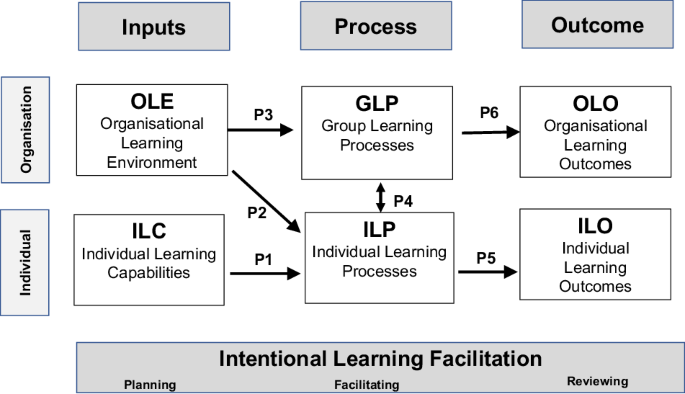
Leadership and Management Learning Framework for accelerated development.
Leadership and management learning framework for accelerated development
Figure 3 provides an overall visual depiction of the leadership and management learning framework. We provide an explanation of each of the six key elements of the framework and the role of facilitation and meta-learning in the framework. We then provide an evidence-based discussion of the relationships between the elements including a discussion of the implications for the facilitation of the leadership and management learning framework.
Inputs
The Organizational Learning Environment (OLE) is a broad, complex set of dynamic organizational characteristics that influence both the organizational and individual learning processes. These characteristics include organizational culture, leadership, opportunities for learning, business learning systems, and decision-making processes. It also includes organizational learning needs or organizationally required capabilities that may be the focus of leadership and management learning interventions.
Individual Learning Characteristics (ILC) are also inputs and include the learning characteristics of each learner such as learning orientation, learning goals, willingness to learn (for example, motivation, and openness), and capacity to learn (intelligence and relevant prior knowledge).
Process
Group Learning Processes (GLP) may be defined as group or organizational processes and practices, to support learners to develop leadership and management capability. Such processes may include action learning projects that address organizational priorities, group reflective practices, or formal group learning activities.
Individual Learning Processes (ILP) are the learning strategy processes that individuals apply to develop competency, solve problems, create solutions, master skills, or develop capability in a workplace context. Critical to the effectiveness of ILP and GLP is the support of a learning facilitator (discussed in detail later in the paper).
Outcomes
Argote (2011) defines organizational learning (OL) as a change in the organization’s knowledge, shared understandings, routines, and behaviours that occurs as a function of experience. This knowledge can be explicit or tacit. Others define OL as the process of learning in an organizational context (Shahriari and Allameh, 2020). For current purposes, the distinction is made between the OL processes and the products or outcomes of that process. Organizational Learning Outcomes (OLO) may be defined more broadly as the change in the organization’s capability, know how, and business processes that result from organizational learning processes (OLP). These enhanced practices and know how, may in turn impact other organizational outcomes such as profitability, sales, or customer satisfaction.
Finally, Individual Learning Outcomes (ILO) describe what a learner knows or is able to do as a result of the learning program or intervention. In terms of leadership and management development, these outcomes may be defined in terms of achieved competencies, which are descriptors of performance. Competencies (competency standards and descriptors) provide a language to discuss and measure management and leadership performance. They are not the performance, nor are they the knowledge, skills, or attitudes that underpin the performance. They provide a reference point to which managers can compare their performance and receive feedback about it.
Theoretical propositions
A series of propositions drawn from the literature are now presented to support the theoretical foundations of the leadership and management learning framework and are summarized in Table 1 below.
link